Wired Differently, Creating Together: Inside the Synesthete Collaborations Blurring Art and Neurology
I want to be careful here, because the word synesthesia has become fashionable in arts writing in a way that has quietly drained it of its meaning. Critics reach for it whenever a choreographer uses color dramatically, or when a painter's surfaces seem to pulse with implied movement. Used this loosely, the term becomes decorative — a way of gesturing at sensory richness without committing to anything specific. What I am describing in this piece is something categorically different: artists whose brains are, in a documented neurological sense, cross-wired, and who are now finding each other and making work together.
The distinction matters enormously, both artistically and ethically. There is a meaningful difference between a painter who finds movement inspiring and one who literally perceives the color E-flat as a specific shade of copper-green. The former is a creative choice. The latter is involuntary, consistent, and verifiable. When genuine synesthetes collaborate, they are not constructing an aesthetic analogy. They are comparing neurological maps.
What Synesthesia Actually Is
For readers unfamiliar with the clinical reality: synesthesia is a neurological phenomenon in which stimulation of one sensory or cognitive pathway automatically and involuntarily triggers a response in another. The most commonly studied form is chromesthesia, or sound-to-color synesthesia, in which musical tones, timbres, or rhythms produce vivid color perceptions. Other forms include spatial-sequence synesthesia, in which numbers or months occupy fixed locations in space, and mirror-touch synesthesia, in which observing another person being touched produces a tactile sensation in the observer's own body.
Estimates suggest that roughly three to four percent of the general population experiences some form of synesthesia. Among artists and musicians, some researchers have proposed the prevalence may be higher, though the causal relationship between synesthetic perception and creative practice remains debated. What is not debated is that the perceptions are real, consistent, and not under voluntary control. A chromesthete who hears a cello and sees amber does not choose amber. Amber simply appears.
The Studio as Laboratory
Consider what it means, then, when a choreographer who experiences movement as color and a painter who experiences color as rhythm enter a shared studio. They are not brainstorming a concept. They are, in a genuine sense, comparing notes on the same phenomenon from different angles.
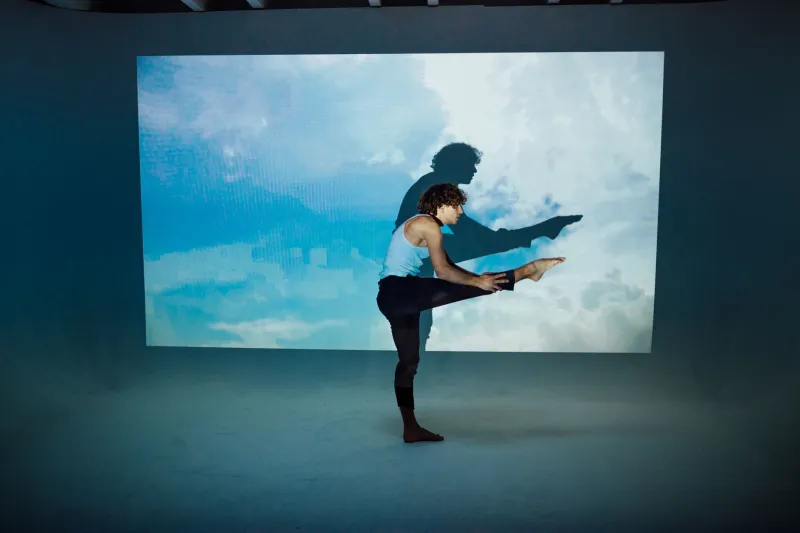
This is precisely the dynamic that animates a small but growing number of collaborations currently emerging in American contemporary performance. In New York, several artists affiliated with the experimental performance community have begun explicitly identifying shared synesthetic perception as the foundation of their collaborative process — not as a marketing frame but as a practical working method. Rehearsals become exercises in translation: the dancer moves a phrase, the painter reports what they see, the dancer adjusts, and the loop continues.
The resulting installations tend to share certain qualities. They are often non-linear in structure, because synesthetic experience does not organize itself narratively. They tend toward simultaneity rather than sequence — painting and movement happening in parallel rather than one illustrating the other. And they frequently produce in non-synesthetic audiences a sensation of witnessing something that cannot quite be explained by what is visibly occurring on stage or on the wall.
The Question of Authenticity
I think it is worth sitting with the uncomfortable question this work raises: does it matter whether the artists are actually synesthetic, and if so, how much?
My position is that it matters a great deal, though not for reasons of purity or gatekeeping. It matters because the work's most interesting claim is not aesthetic but epistemological. Synesthete collaborations, at their most rigorous, are proposing that artistic form can be a direct transcription of neurological experience — that the painting on the wall is not a representation of what the artist felt but a record of what the artist's brain produced involuntarily. This is a genuinely radical proposition, and it is one that only holds if the neurological condition is real.
When the claim is metaphorical, the work becomes something else: evocative, possibly beautiful, but no longer making the same argument. There is nothing wrong with metaphor, of course. But conflating the two categories does a disservice to artists whose work is grounded in something verifiable and to audiences trying to understand what they are actually seeing.
What This Means for the Intersection of Movement and Image
For those of us who think seriously about the relationship between dance and visual art — which is, after all, the animating question of this publication — synesthete collaboration offers a provocation that goes beyond any individual work or artist.
It suggests that the boundary between movement and image may be, for some minds, not a boundary at all. That what appears to be a metaphorical connection — dance as painting, painting as dance — might, for a neurologically distinct subset of human beings, be a literal description of experience. And it raises the possibility that the art forms we have kept institutionally separate (the dance world, the gallery world, the concert hall) have been organized around a sensory architecture that is not universal.
At Ink & Dance, we have always proceeded from the intuition that movement and visual expression are more deeply entangled than the cultural infrastructure around them acknowledges. The synesthetes who are making work together right now are not illustrating that intuition. They are, in their own involuntary and extraordinary way, proving it.
The ink and the dance, it turns out, were never separate to begin with. For some minds, they never could be.