The Algorithm Walks Into the Gallery: Why TikTok Dance Deserves a Place on Museum Walls
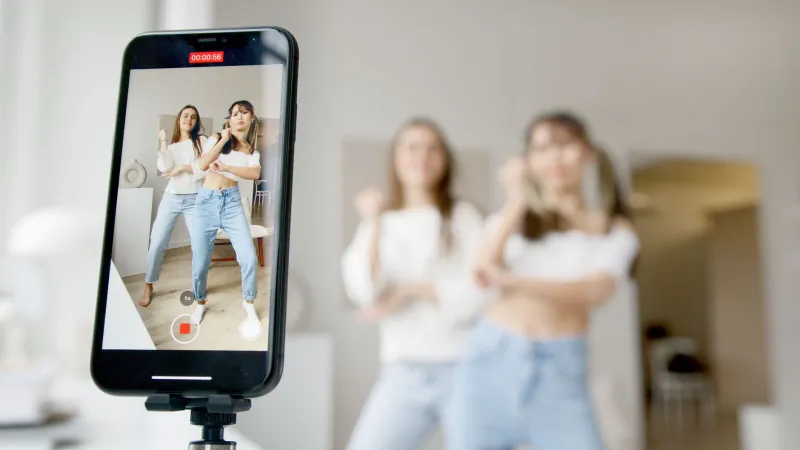
The art world has always had a complicated relationship with popularity. The Impressionists were once considered too accessible. Jazz was dismissed as noise. Street art spent decades being painted over before Jean-Michel Basquiat's canvases started selling at auction for nine figures. Each time, the institution eventually caught up with the culture. We are living through the next iteration of that familiar drama, and its stage is a four-by-seven-inch screen.
TikTok dance — the short-form, algorithmically distributed choreography that has become the defining popular movement culture of this decade — is beginning to appear in American museums and galleries. Not as documentation of a trend. As art.
The Dismissal and Its Discontents
The case against treating viral choreography as fine art is easy to recite. The works are brief. They are designed for frictionless consumption. They are created within platform constraints — a maximum duration, a vertical frame, a pre-existing audio track — that seem to preclude the kind of deliberate, autonomous artistic decision-making that fine art has traditionally required. And they are popular, which in certain critical circles remains a disqualifying condition.
I find none of these objections persuasive when examined carefully.
Brevity is not a deficiency. The haiku is brief. The Polaroid photograph is brief. The constraint of short form has historically concentrated artistic intention rather than diluting it. The vertical frame is simply a new aspect ratio — no more inherently limiting than the 4:3 dimensions that governed early cinema or the square format of medium-format photography. And the use of pre-existing audio is, in the tradition of sampling, remix culture, and found-sound composition, a legitimate and sophisticated artistic practice.
As for popularity: the notion that wide audiences and artistic seriousness are mutually exclusive is a prejudice, not a principle.
The Creators Who Bridged the Divide
Consider the trajectory of Addison Rae Brewer, a Chicago-based choreographer who built an audience of several million on TikTok through a distinctive practice of setting classical ballet vocabulary against contemporary hip-hop production. What began as a personal creative experiment became, over the course of two years, a coherent body of work with identifiable aesthetic preoccupations: the friction between codified, historically European movement systems and the rhythmic architecture of Black American music. That is not a trivial artistic concern. It is, in fact, a central tension in the history of American dance.
In 2023, Brewer was commissioned by the Museum of Contemporary Art Chicago to develop an expanded version of her digital practice for gallery installation. The resulting work, presented across six vertical screens arranged in a hexagonal formation, was reviewed by the Chicago Tribune as "one of the more formally rigorous explorations of the body in institutional space this season." The work did not succeed because it escaped its TikTok origins. It succeeded because those origins were legible and meaningful — the platform's constraints visible as artistic decisions rather than accidents.
Brewer's case is not isolated. In Los Angeles, the Hammer Museum has hosted screenings and panel discussions featuring digital choreographers whose primary platforms remain social media. The Whitney Museum in New York included short-form video dance in its most recent consideration of performance documentation. These institutions are not slumming. They are recognizing something that critics resistant to the form have been slow to acknowledge.
What the Platform Actually Demands
One of the persistent misunderstandings about TikTok choreography is that it requires less craft than concert dance. The opposite is frequently true. Creating movement that communicates a coherent aesthetic identity, emotional arc, and physical specificity within sixty seconds — while accounting for the compression of digital video, the absence of live spatial context, and the competitive environment of an infinitely scrolling feed — demands a precise and sophisticated understanding of how bodies read on camera.
The best practitioners of this form have developed genuine expertise in what might be called choreographic compression: the art of eliminating everything that does not carry maximum expressive weight. Watching a creator like Fik-Shun or Keone Madrid work within the short-form format is to watch artists who understand, at a cellular level, that every frame is accountable. There is no filler. There is no transitional material that the audience will forgive because the next section will reward their patience. Every second either earns its place or loses the viewer entirely.
This is not a lower standard than concert dance. It is a different standard, and in some respects a more exacting one.
The Institutional Reckoning
American art institutions are, to their credit, beginning to grapple with the implications of this. The question is whether they will engage authentically or merely perform relevance. There is a meaningful difference between a museum that commissions a digital choreographer to create new work within a gallery context — treating that creator as a peer whose practice merits institutional support — and a museum that mounts a retrospective of viral videos as a sociological exhibit, framing popular dance as an artifact to be studied rather than an art to be experienced.
The former is curatorial seriousness. The latter is condescension dressed as inclusion.
The institutions doing this well are the ones that have allowed the aesthetic logic of the work to drive the exhibition design, rather than imposing traditional fine art presentation frameworks onto material that operates by different rules. Vertical screens, not horizontal projections. Sound design that honors the original audio relationships rather than substituting ambient gallery music. Programming that invites the creators to speak about their practice in the same terms and with the same institutional gravity afforded to painters and sculptors.
Where Ink Meets the Feed
At Ink & Dance, our editorial commitment is to the places where movement and visual art find each other. For most of the site's history, that has meant concert stages, gallery installations, and collaborative performances. But the screen is also a canvas. The feed is also a stage. And the choreographers who have built their practices within those digital spaces deserve the same critical attention we extend to anyone else working at the intersection of the body and the image.
The algorithm did not create these artists. It distributed them. The distinction matters. The art was always there. We are simply, finally, beginning to look.