Seeing in Motion: The Artists Who Turn Color Into Choreography
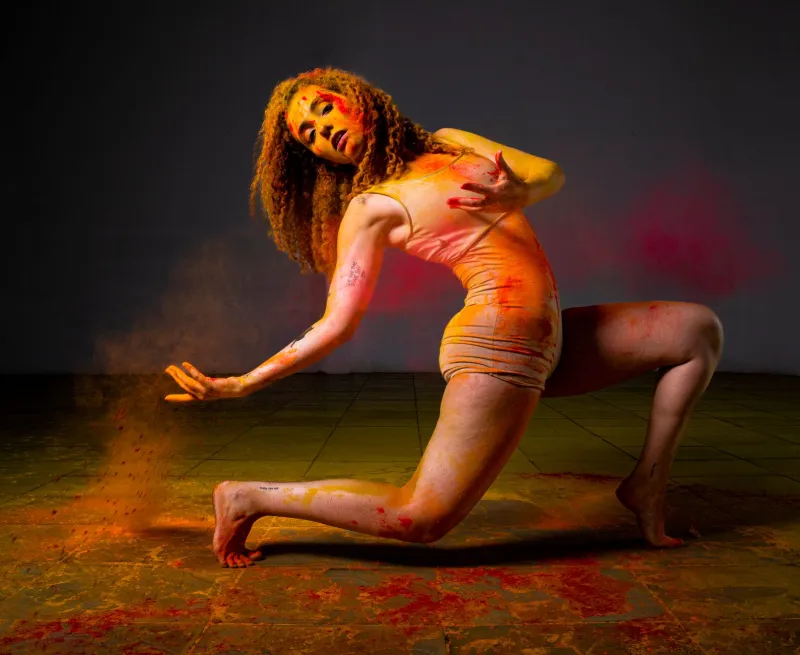
There is a moment in certain performances when the boundary between what you see and what you feel dissolves entirely. A wash of deep indigo floods the stage, and the dancer's spine curves in immediate, unspoken response. Crimson enters from the wings, and the tempo of every limb accelerates. These are not accidents of lighting design. They are deliberate translations — color rendered as movement, pigment transformed into physical vocabulary.
Across the United States, a distinct cohort of choreographers and visual artists are building collaborative practices around exactly this premise. Their work sits at the precise intersection that Ink & Dance was created to explore: the place where the canvas breathes and the body paints.
The Neurological Foundation
Before examining the art, it is worth understanding the science that makes it plausible. Synesthesia — the neurological phenomenon in which stimulation of one sense involuntarily triggers another — affects an estimated four percent of the population. For these individuals, specific colors may carry inherent weight, temperature, or even sound. But researchers have increasingly demonstrated that a milder, more diffuse version of cross-sensory perception operates in nearly all human brains. Studies conducted at institutions including the California Institute of Technology and the University of California, San Diego have documented consistent associations between color saturation and perceived physical energy, between cool tones and contracted movement, between warm hues and expansive gesture.
Choreographers have long intuited these connections. What is new is the deliberate, methodological rigor with which contemporary companies are applying them.
The Palette as Score
New York-based choreographer Elena Vasquez describes her process as "reading color the way a musician reads a score." Working in sustained collaboration with painter and installation artist Marcus Thorn, Vasquez develops each new work by spending weeks inside Thorn's studio before a single movement phrase is set. She does not observe the painting process as a passive witness. She responds to it physically, improvising in real time as new colors and textures emerge on the canvas.
"Marcus might introduce a burnt sienna passage into a piece that had been almost entirely cool and muted," Vasquez explained in a recent conversation. "My body registers that as an intrusion, something warm and slightly aggressive entering a contained space. The movement that comes out of that moment is completely different from anything I would have arrived at through conventional choreographic research."
The resulting performances are structured around Thorn's finished canvases, which are displayed onstage throughout. The paintings do not serve as backdrop. They function as co-authors, their specific chromatic decisions visible and legible to anyone watching the dancers navigate each section.
Medium as Movement Vocabulary
Other practitioners have extended the inquiry beyond color into artistic medium itself. Chicago-based collective Groundwork Dance has spent the past three seasons developing a methodology in which different visual art materials — charcoal, watercolor, oil paint, encaustic wax — generate distinct movement qualities. Charcoal, with its capacity for both precise mark-making and broad, smudging erasure, informs a vocabulary of sharp initiations that blur into sustained, unresolved afterimages. Watercolor, with its transparency and tendency toward unpredictable spread, yields improvisational structures in which the dancer commits to an initial impulse and then surrenders control of where it travels.
Groundwork's artistic director, Jerome Okafor, is careful to distinguish this approach from mere metaphor. "We are not asking dancers to pretend they are paintbrushes," he said. "We are asking them to understand the physical logic of how a material behaves and to locate an equivalent logic inside their own bodies. The medium teaches the body something the mind would not have found on its own."
Audience Perception and the Multi-Sensory Contract
Perhaps the most compelling question these works raise is not how they are made, but how they are received. When an audience member watches a dancer respond to cadmium yellow, are they witnessing a private system of meaning that requires explanation to be legible? Or does the chromatic-kinetic relationship communicate directly, bypassing the interpretive mind entirely?
Anecdotal evidence from post-performance discussions suggests that audience members frequently perceive the color-movement correlations without being told they exist. At a recent Groundwork performance in Chicago's Steppenwolf Theatre complex, several audience members independently noted that the section performed against a predominantly ochre and rust palette felt "warmer" and "more urgent" than earlier passages — a reading that precisely matched the choreographic intention.
This directness of communication may be the defining artistic achievement of this emerging practice. In a cultural landscape increasingly saturated with mediated experience, these performances offer something rare: sensation that arrives before interpretation, understanding that lives in the body before it reaches the analytical mind.
The Collaborative Ethics
It would be incomplete to discuss this work without acknowledging the power dynamics inherent in any collaboration between visual artists and performing artists. The history of such partnerships is not without tension. Dancers have sometimes found themselves cast as living accessories to a visual artist's primary vision; painters and sculptors have occasionally experienced their work reduced to decorative scenery.
The most successful of the current generation of collaborators appear to have navigated this through structural equity from the outset. In Vasquez and Thorn's partnership, neither artist's medium holds precedence. The finished performances are credited jointly, marketed jointly, and reviewed as unified works. When critics have attempted to separate the choreography from the visual art for evaluative purposes, both artists have pushed back publicly.
"The work doesn't exist in either of our studios," Thorn noted. "It only exists in the space between them. That's where we both have to live."
A Practice Still Finding Its Language
For all its rigor and ambition, chromatic choreography remains a practice without a settled critical vocabulary. Reviewers reach for terms borrowed from music theory, from color psychology, from somatic practice, and from visual art criticism — sometimes within a single paragraph. This linguistic instability is not a weakness. It is evidence that the form is genuinely new, genuinely demanding, and genuinely expanding the territory available to both dance and visual art.
At Ink & Dance, that expansion is precisely the story worth following. The canvas and the body have always shared more than proximity. The artists working at this intersection are making that shared language visible, one color, one gesture, one irreducible moment at a time.