Close Enough to Hear the Breath: The Case for Underground Dance and What It Costs Us
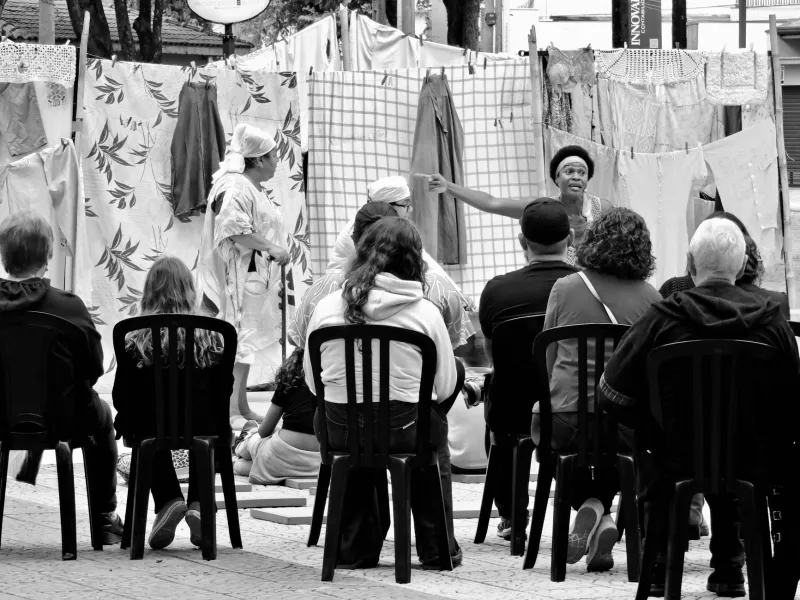
I attended a dance performance last winter in a warehouse on the outskirts of a mid-sized American city. The space smelled of sawdust and cold concrete. Folding chairs had been arranged in a loose semicircle no more than eight feet from where the performers would move. There were forty-seven people in the room—I counted, because counting felt like the right thing to do in a space that small, where every person's presence was so palpably felt.
What happened in that warehouse over the following seventy minutes was some of the most affecting dance I have witnessed in years. Not because the choreography was extraordinary by any conventional measure, though it was accomplished. Because the proximity was total. I could hear the performers breathe. I could see the effort in their faces—not as spectacle, but as fact. When one dancer wept during the final section, I did not wonder whether it was performance. I simply sat with it, the way you sit with something true.
I have been thinking about that evening ever since, and not entirely with uncomplicated admiration.
The Underground Turn
Across American cities—Brooklyn, Los Angeles, Chicago, Denver, Austin, and beyond—a discernible shift is underway in where significant dance work is being made and shown. Institutional venues, for all their technical resources and cultural legitimacy, are losing ground to spaces that were never designed for performance: warehouses, galleries, private homes, rooftops, storefronts, and church basements. The work being shown in these spaces is not uniformly underground in the countercultural sense—some of it is made by artists with substantial reputations and serious funding. What unites it is an orientation toward intimacy, toward the dismantling of the formal distance that proscenium stages impose between art and audience.
The reasons for this shift are multiple and not always aesthetic. Institutional venues are expensive to rent, and the gatekeeping structures that govern access to them—programming committees, presenter relationships, season calendars—are slow and often conservative. For independent artists working outside established companies, the institutional stage is frequently simply unavailable. The underground venue, by contrast, requires only a willing host and a room large enough to move in.
But something more than economic necessity is driving this turn. Audiences are actively seeking these experiences. Underground showcases in major cities routinely sell out through word-of-mouth alone. Mailing lists for invitation-only performance series carry waiting lists. There is a hunger here that institutional programming, for all its resources, is not satisfying.
What Proximity Does
The case for intimate performance is not difficult to make, and I will not pretend otherwise. The proscenium stage is a magnificent invention and a limiting one. It organizes the relationship between performer and audience as a relationship between the observed and the observer—a relationship of distance, of aesthetic remove, of the kind of controlled attention that produces admiration more readily than it produces encounter.
Close performance does something different. When an audience is eight feet from a moving body, the conventional apparatus of theatrical spectatorship—the darkened house, the elevated stage, the implicit instruction to watch from a position of aesthetic sovereignty—gives way to something more unruly and more honest. The audience is implicated. Their breathing enters the room. Their physical responses—a shift in a chair, a held breath, an involuntary sound—become part of the performance's texture.
This is not a minor difference. It is a fundamental reorientation of what a performance encounter is and what it asks of both parties. The artists I have spoken with who work primarily in underground or non-traditional venues describe a quality of attention from their audiences that they rarely encounter in conventional theater settings. "People are present in a different way," says one Brooklyn-based choreographer who declined to be named because she performs in spaces that do not have performance permits. "They can't disappear into the dark. They're in it with you."
The Questions That Proximity Cannot Answer
And yet. The warehouse I attended last winter was reached by car, in a neighborhood without reliable public transit, on a weeknight evening in December. The forty-seven people who gathered there were, without exception, already embedded in the dance community—artists, critics, educators, and their immediate social circles. There was not a single person in that room who had encountered the work by accident, or who had seen a poster, or who had purchased a ticket through a box office accessible to a general public.
This is not incidental. It is structural. The underground performance scene, for all its genuine vitality and artistic ambition, is also a scene—a social formation with its own boundaries, its own insider logic, and its own forms of exclusion. The intimacy that makes these events so powerful is inseparable from the selectivity that makes them inaccessible to most people who might benefit from them.
Institutional venues, for all their limitations, offer something the underground cannot easily replicate: discoverability. A person who has never attended a dance performance can purchase a ticket to a show at a regional theater and encounter work that changes them. That pathway is not available in a warehouse reached by private invitation and word-of-mouth.
The accessibility question is not merely logistical—it is artistic and ethical. If the most vital dance work in American cities is being made in spaces that require insider knowledge to find, then we are not democratizing performance culture. We are, in some meaningful sense, concentrating it.
Holding Both Truths
I do not think the underground turn is a mistake. The work being made in these spaces is too alive, too necessary, and too honest about the limits of institutional performance to be dismissed or discouraged. The proximity these venues afford is not a gimmick—it is a genuine formal innovation, a recalibration of what a performance encounter can be.
But I think the movement's advocates sometimes speak as though intimacy and accessibility are the same thing. They are not. A performance can be deeply intimate and profoundly exclusive simultaneously. The warehouse I attended was both.
The most interesting question facing American dance culture right now is not whether underground performance is artistically valuable—it clearly is—but whether its defining qualities can be extended beyond the communities that currently have access to them. Can the proximity, the unmediated encounter, the refusal of aesthetic distance, be brought to audiences who are not already inside the room?
That is a harder problem than finding a warehouse. It is also, I would argue, the more important one. The breath in a performance space should be available to everyone willing to draw close enough to hear it.