Traces on the Floor: The Forgotten Archive Beneath Every Dance Studio
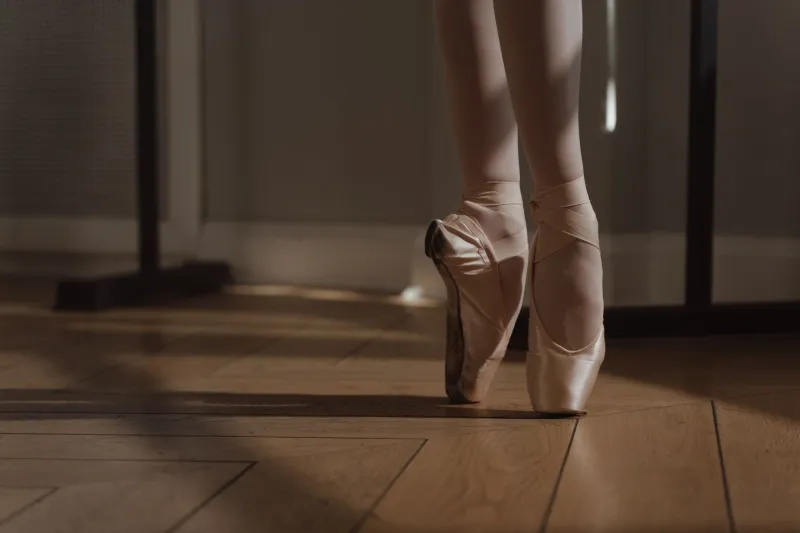
Somewhere in a building slated for renovation in Seattle's Capitol Hill neighborhood, there is a studio floor that has not been refinished in thirty-one years. Beneath the scuff marks and the pale, abraded channels worn into the wood by decades of pivoting feet, beneath the amber residue of rosin and the faint geometric shadows left by generations of portable barres, there is a record. Not a tidy one. Not the kind that sits in an archive box or loads cleanly into a database. But a record nonetheless — of how bodies moved through this space, how they learned, how they failed, how they returned.
When the building's new owners announced plans to gut the interior, the studio's longtime director sent a single photograph to a group chat. The caption read: They're taking the floor.
The responses, from former students and faculty scattered across the country, were immediate and visceral in a way that surprised even those sending them. Something about that floor — its particular damage, its accumulated evidence of effort — had lodged in people's bodies as surely as any technique they'd learned there.
This is the argument this piece wants to make: that the material traces left by dance are not incidental, not merely the detritus of physical labor, but constitute a genuine and largely unacknowledged archive. And that our collective failure to recognize them as such says something uncomfortable about how American culture values performance — or, more precisely, how it doesn't.
What the Studio Holds
The physical vocabulary of a well-used dance studio is specific and, once you learn to read it, extraordinarily legible. Rosin dust accumulates differently depending on the style of work practiced in a space: ballet studios tend to show it concentrated at the barre and at center-floor turning spots; tap studios distribute it in rhythmic streaks that trace the most-traveled pathways. The wear patterns on a wooden floor map the spatial logic of a particular pedagogy with remarkable precision — which corners were used for traveling combinations, where the teacher stood, which spots were avoided because the springing was uneven.
Mirrors, too, hold information. The scratches at hip height in a studio that trained generations of ballroom dancers. The handprints at child-level in a youth program's space. The smudges at eye level where performers checked their alignment so many times that the reflective surface has been permanently altered.
Installation artist and former dancer Priya Mehrotra began documenting these surfaces in 2019 as part of a project that has since grown into a traveling exhibition titled Evidence of Practice, which opened most recently at a gallery in Minneapolis. Her process involves photographing studio floors and walls in high resolution, then producing large-format prints that isolate specific areas of wear and present them as the primary subject rather than the background.
"People walk into the exhibition and they don't always know immediately what they're looking at," Mehrotra says. "And then something shifts — they recognize the texture, or the scale of the wear pattern, and they understand that this is a place where people worked. Really worked. And they feel it differently."
The Archaeology of Effort
What Mehrotra's project surfaces — and what makes it genuinely provocative — is the question of why this documentation hasn't happened more systematically, earlier, and with institutional support.
American dance has a preservation problem that is well-documented in its own field. The ephemeral nature of performance means that the primary record of most choreographic work is fragmentary: video documentation that captures only what the camera could see, written notation systems that require specialized training to read, oral histories that depend on the memories of practitioners who are themselves aging. The field has spent decades developing tools to address this gap, from Labanotation to digital motion capture.
But the material record — the physical evidence left in the spaces where dance was made and learned — has received almost no comparable attention. Studios are renovated, demolished, or repurposed without documentation. Floors are refinished. Mirrors are replaced. The accumulated evidence of decades of practice is discarded as maintenance, not recognized as history.
This is not, it should be said, simply an oversight. It reflects a deeper cultural assumption: that what matters about dance is the performance, the finished work, the moment of public presentation. The labor that produces that moment — the years of daily practice, the repetition, the physical negotiation with gravity and resistance — has been understood as preparatory, not primary. The studio is a backstage to the stage.
But that framing is worth interrogating. The studio is where most of dance actually happens. For every hour spent in performance, a professional dancer will have spent hundreds in rehearsal and training. If we want to understand dance as a practice — not just as a product — the studio is precisely where we should be looking.
Reclaiming the Material Record
A small but growing number of artists and scholars are beginning to make that argument explicitly.
In New York, the organization Dance NYC has been quietly compiling documentation of studio spaces in neighborhoods that have experienced significant real estate pressure, recognizing that the displacement of dance studios from Manhattan and Brooklyn is not only a logistical crisis for working artists but a cultural loss with archival dimensions. Photographs, floor plans, and material samples from studios that have closed or relocated are being gathered into a collection that the organization describes, with deliberate provocation, as an archaeological deposit.
At the University of California, Los Angeles, dance historian Dr. Simone Park has been developing a methodology she calls spatial choreography analysis — a framework for reading studio environments as primary sources in the same way that historians read documents. Her forthcoming book argues that the material conditions of dance studios in mid-twentieth-century America encoded significant information about race, class, and gender in ways that supplement and sometimes contradict the official histories of the same period.
"The floors don't lie in the way that institutional records sometimes do," Park says. "A studio that claimed to be integrated but whose floor shows two distinct wear patterns — one in the main space, one in what was clearly a secondary area — is telling you something that the brochures won't."
Why It Matters Now
The timing of this conversation is not incidental. American dance studios have been under extraordinary pressure for the better part of a decade — from rising real estate costs in urban centers, from the disruptions of the pandemic, and from a broader cultural economy that has consistently underinvested in the infrastructure of live performance. Spaces that have housed decades of practice are closing at a rate that feels, to many in the field, like an emergency.
Recognizing the archival value of these spaces does not, by itself, save them. But it changes the terms of the conversation about what is being lost when they go. A studio floor is not just a surface. It is, if we are willing to read it, a document — imperfect, partial, and irreplaceable — of how American bodies moved through space, how they were trained and shaped and disciplined, and what they made of the time they were given.
That record deserves more than a renovation dumpster. It deserves, at minimum, our attention.