Pencil Before Playlist: How America's Choreographers Are Returning to the Handmade Score
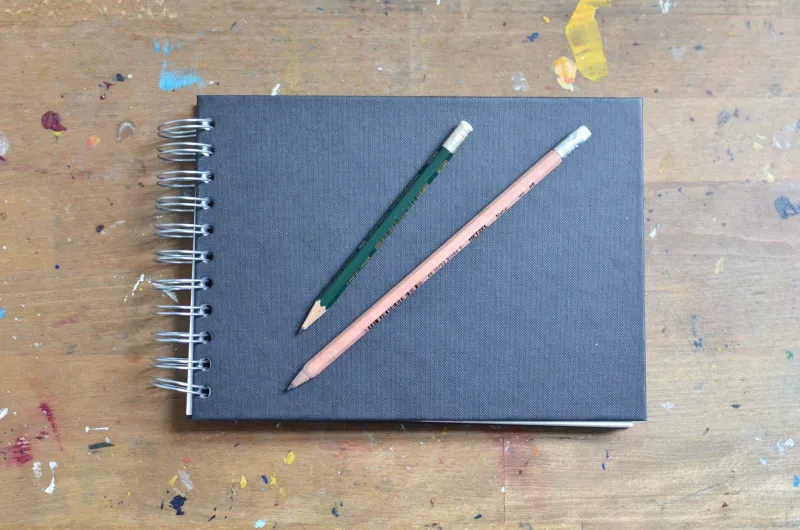
There is something quietly radical about a choreographer who, surrounded by motion-capture software, cloud-synced rehearsal apps, and high-definition video playback, reaches instead for a pencil. Yet across rehearsal studios from Brooklyn to Los Angeles, that is precisely what is happening. A growing number of working dance makers are abandoning the clean efficiency of digital tools in favor of sketchbooks, collage, drafting paper, and mixed-media journaling as their primary methods of compositional thinking. The movement — if one can call it that — is less a manifesto than a practical reckoning: something essential was being lost in the translation from screen to stage, and paper, it seems, has been quietly holding the answer all along.
The Problem With the Perfect Interface
Digital tools promised choreographers everything: instant notation, shareable files, searchable archives, and near-infinite revision without waste. Platforms like Choreographic Language Agent and various Laban-derived software applications brought a new kind of precision to the pre-production process. But precision, several choreographers argue, is not always the point — and may, in fact, be the obstacle.
"When I open a laptop, I'm already operating inside someone else's logic," says one New York–based contemporary choreographer who has worked with major regional dance companies across the Northeast. "The software has opinions. It wants me to categorize, to label, to fit movement into fields that already exist. A blank piece of paper has no opinions whatsoever."
That blankness — the radical openness of an unmarked page — is precisely what choreographers describe as the analog tool's most undervalued quality. Unlike a digital interface, which arrives pre-structured with menus, grids, and templates, a sketchbook offers no hierarchy of importance. A gesture can be rendered as a word, a line, a torn magazine image, or a smear of watercolor wash. The compositional idea determines the form of its own notation, rather than conforming to a form that already exists.
Marks That Move
For many choreographers, the physical act of drawing is itself a form of movement research. The hand that sketches a curved arc across a page is, in some neurological sense, rehearsing the same arc it hopes to see performed. Several dance makers describe their sketchbooks less as planning documents and more as kinetic diaries — records of the body thinking through the hand.
One Los Angeles–based choreographer, whose work sits at the intersection of West African dance traditions and contemporary American concert dance, keeps what she calls a "collision book" — a large-format journal in which photographs, fabric swatches, handwritten phrases, and gestural drawings are layered on top of one another without hierarchy. "I'm not trying to describe what the dance will look like," she explains. "I'm trying to feel what it wants to be. The collage lets me put things next to each other that software would never let me put next to each other."
That quality of unexpected adjacency — the visual surprise of two unrelated images pressed against each other on a page — is something choreographers cite repeatedly as a generative force that digital tools actively suppress. Algorithms, after all, are designed to recognize and reinforce patterns. Collage is designed to violate them.
The Rehearsal Room and the Sketchbook
What happens to these analog documents once rehearsals begin? The answer varies considerably, and the variation itself reveals something about how different choreographers understand the relationship between planning and discovery.
Some treat the sketchbook as a private score, never shared with dancers, functioning instead as an internal compass the choreographer consults when the work loses its direction. Others bring pages directly into the studio, taping drawings to the mirror or the wall as visual anchors for a day's work. A few choreographers have developed hybrid practices in which specific sketchbook pages are photographed and shared with designers, lighting directors, or composers as a form of mood documentation that resists the clinical language of a formal production brief.
"I gave my lighting designer a page from my sketchbook once," recalls a Chicago-based dance theater artist. "It was just a smudged charcoal drawing of what I was thinking about — a body half-dissolved into shadow. She looked at it for a long time and said, 'I understand.' We never had to have a long technical conversation. The drawing said everything the words couldn't."
Imperfection as Compositional Strategy
Underlying all of these practices is a shared philosophical position: that imperfection is not a flaw in the compositional process, but a feature of it. The smudge, the crossed-out phrase, the drawing that doesn't quite capture what the hand intended — these are not failures. They are evidence of the work thinking.
Digital tools, by contrast, are designed to eliminate the trace of effort. Version histories can be deleted. Revisions can be made without record. The file that opens on screen presents only the current state of a thought, scrubbed of the struggle that produced it. For choreographers who understand process as inherently meaningful — who believe that the path to a movement phrase is as significant as the phrase itself — this erasure is not neutral. It is a loss.
The sketchbook, by contrast, accumulates. Pages fill. Layers build. The early, uncertain marks remain visible beneath the later, more confident ones. The choreographer who returns to a sketchbook weeks into a rehearsal process finds not just their current thinking, but the entire archaeology of how they arrived there.
What the Screen Cannot Hold
It would be reductive to frame this resurgence as anti-technology sentiment. Most of the choreographers engaged in these analog practices are not rejecting digital tools entirely. Video documentation, cloud-based scheduling, and digital communication remain practical necessities of the contemporary dance world. What they are rejecting is the assumption that digital tools are inherently superior for all stages of the creative process — and, more pointedly, the assumption that the compositional imagination should be shaped by the logic of the interface.
The sketchbook asks nothing of the choreographer except attention. It does not auto-save, auto-correct, or suggest alternatives. It does not log the user out after a period of inactivity or require a software update before the work can continue. It is, in the most literal sense, always available — and always patient.
In a creative culture increasingly mediated by platforms that profit from engagement and optimization, there is something almost countercultural about the choreographer who begins their compositional day by opening a worn notebook and picking up a pencil. Not because it is faster or more efficient or more shareable. But because the hand moving across paper is, in its own small way, already dancing.
And for the dance maker, that is where every work worth making has always begun.