When the Music Stops: How Visual Artists Are Reshaping the Way Dancers Listen With Their Bodies
There is a particular kind of discomfort that settles over a rehearsal room when the speakers go silent — not the brief pause between tracks, but a permanent, intentional quiet. For many dancers, that silence is the equivalent of pulling the floor out from under them. Rhythm, phrasing, emotional cue, structural scaffold: music performs all of these functions simultaneously, and its removal exposes just how dependent most movement training has become on audio architecture.
A growing number of interdisciplinary collaborations across the United States are treating that discomfort not as a problem to be solved but as a creative territory worth inhabiting. Painters, sculptors, and installation artists — practitioners whose own work has never required a soundtrack — are entering studio spaces and asking dancers to do something radical: move as though sound were not an option.
The results, by most accounts, are transformative in ways that neither discipline fully anticipated.
The Visual Artist as an Unlikely Dramaturg
The premise of these partnerships is deceptively simple. A visual artist, versed in the grammar of composition, negative space, and material tension, enters a choreographic process not to dictate steps but to reframe how a dancer perceives time and space. Without music anchoring the work, the dancer must locate those qualities elsewhere — in the geometry of a room, in the texture of a surface, in the physical relationship between bodies occupying a shared plane.
Sculptor and installation artist Renata Voss, based in Chicago, has spent the last three years leading what she calls "silent residencies" with contemporary dance companies in the Midwest. Her background is in large-scale steel fabrication, and she brings to the studio a sculptor's attentiveness to mass, weight, and the way objects negotiate space. "I'm not teaching dancers to be mute," Voss explains. "I'm asking them to discover what they're actually saying when no one else is filling in the gaps for them."
In her residencies, Voss introduces visual prompts — photographs of her own installations, architectural drawings, color-field reproductions — as the only external stimuli available to the dancers. The absence of music is not framed as deprivation. It is framed as invitation.
Precision as a Byproduct of Constraint
What practitioners in this space consistently report is that silence does not produce vagueness. Counterintuitively, it produces exactitude. When a dancer cannot lean on a musical phrase to tell them when to extend an arm or shift their weight, that decision must be made with full conscious ownership. Every choice becomes visible — not to an audience, but to the dancer themselves.
New York-based choreographer and interdisciplinary performer Desmond Achebe encountered this dynamic during a yearlong collaboration with a Brooklyn painter whose large-format abstract canvases served as the conceptual backdrop for a site-specific work. "I realized how much I had been using music as a kind of permission slip," Achebe reflects. "The crescendo tells you when to jump. The rest tells you when to pause. Take all of that away and you have to ask yourself: why am I moving right now? What is actually compelling this?"
That question — deceptively simple, genuinely difficult — sits at the center of what these visual-art collaborations are surfacing. It is not a question that most conservatory training spends significant time with. The result, Achebe notes, was movement that felt both more deliberate and more alive. "There's a kind of honesty that comes with silence. You can't hide behind a beautiful piece of music."
The Canvas as Score
Perhaps the most formally inventive aspect of these collaborations is the way visual artworks are being repurposed as structural replacements for musical scores. A painter's canvas, read left to right, top to bottom, can suggest duration, density, and transition. A sculptor's arrangement of forms across a floor plan can imply pathways, pauses, and points of convergence.
This is not an entirely new idea — the work of Merce Cunningham and his long partnership with visual artists including Robert Rauschenberg and Jasper Johns famously decoupled choreography from music, treating the two as parallel but independent streams. What distinguishes the current wave of collaborations is the degree to which the visual artist is not merely a designer of the environment but an active participant in choreographic thinking.
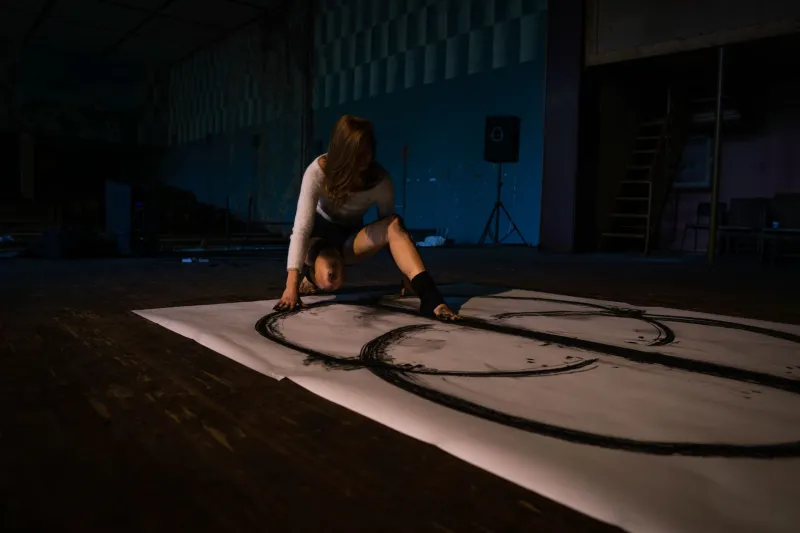
In Los Angeles, painter and muralist Solange Fierro has been working with a contemporary dance collective to develop what she describes as "temporal paintings" — works created in real time alongside rehearsal, in which the accumulation of marks on canvas directly mirrors and occasionally redirects the movement unfolding in the room. Neither the painting nor the dance leads. They negotiate.
"I'll make a long horizontal gesture and one of the dancers will respond by crossing the space in a slow diagonal," Fierro says. "There's no plan. But there's a logic. We're both reading the same room."
What Silence Reveals About Sound
One of the more unexpected outcomes reported across multiple collaborations is a deepened relationship with music itself — once it is eventually reintroduced. Dancers who have worked extensively in silence describe returning to scored work with a significantly altered listening posture. Rather than riding the music, they begin to move alongside it, treating it as one voice among several rather than the primary authority in the room.
This shift has implications that extend well beyond experimental practice. For dancers working in commercial, theatrical, or competitive contexts, the capacity to move with genuine internal conviction — rather than in reactive response to an external beat — can be the difference between technically proficient performance and something that genuinely communicates.
Voss frames it in terms familiar to any visual artist: "A painting doesn't need music to have rhythm. It doesn't need music to have tension or release or a sense of time passing. Dancers are capable of all of those things too. They just haven't always been asked to find them on their own."
The Institutional Conversation
For all their creative richness, these collaborations occupy an uncertain position within the institutional structures of both dance and visual art. Dance presenters are not always equipped to contextualize work that emerges from a visual-art methodology. Galleries and museums, conversely, are still developing frameworks for performance practices that resist documentation and object-based legibility.
There is, however, a discernible momentum. Residency programs that bridge disciplines — among them several supported by regional arts councils and university arts centers — are increasingly creating structured opportunities for exactly this kind of cross-training. The conversation is widening.
What remains consistent, across geography and medium and artistic biography, is the experience of the silence itself: not as absence, but as a different kind of fullness. A room without music is not an empty room. It is a room in which the dancer, finally, must speak for themselves.
And it turns out they have quite a lot to say.